
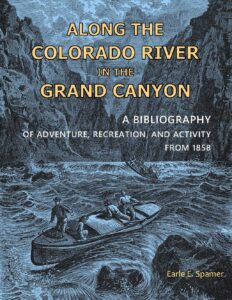
THE GRAND CANON VOLUME 5 (1st Edition, 2026)
Along the Colorado River in the Grand Canyon: A Bibliography of Adventure, Recreation, and Activity from 1858
This is the first bibliography dedicated to activities along the Colorado River in the Grand Canyon.
Front matter in this volume comprises several brief, illustrated historical essays relating to the Colorado River in Grand Canyon.
“The Grand Canyon” is specially defined for this bibliography of adventure, recreation and activity—the course of the Colorado River from Lees Ferry to the Grand Wash Cliffs. The fluvial and physiographical Grand Canyon, geographically mapped, begins about at the confluence of the Little Colorado River, reached after 61 miles of downstream travel from “the Ferry” through Marble Canyon. But the Ferry is also coincidentally where the Grand Canyon’s geological strata first appear at river level. Thus, the “rim rocks” of the Grand Canyon are met here and a Colorado River trip truly proceeds down through the great canyon’s strata. About 277 miles downstream from the Ferry the Colorado exits from the Grand Canyon through the Grand Wash Cliffs, a palisade that delineates the decisive physiographical and geological boundary between two major provinces of North America, the Colorado Plateau (on the east and northeast at this point) and the Basin and Range (on the west and south). By convention, a boat trip starting from Lees Ferry and passing through the Grand Wash Cliffs defines a complete “Grand Canyon river trip.” For practical if not geographical necessity, a few references are added to this bibliography that extend the trip beyond Grand Wash to Pearce Ferry, a traditional take-out place for many Grand Canyon trips, located on present-day Lake Mead.
A separate section, "Downriver", is devoted to a listing of obituary notices and memorials, arranged by the names of decendents.
The bibliography is purposely not comprehensive. There are many publications—scientific ones mostly, though with exception—that are deemed to be not specifically of “human interest”, at least in the same fashion as which are items about adventure and recreation. Bibliographies with environmental interests, and studies of biological organisms, have been separately produced by Raven’s Perch Media; to include such topics in this bibliography except in special sections would be distracting, though a few are added to the main bibliography because they have overlapping human-interest themes.
Two major categories not expressly of “human interest”, but nonetheless are humanly engaged, are relegated to separate sections: “Administrative Perspectives” and “Hydraulics and Hydrogeology”. They are not ignored because they are deemed significant for their attention to ongoing issues pertaining to the river, affecting groups and individuals. The administrative items also encompass a broad sphere of wrangling public opinion and action that relates to these issues. Also included is a separate section for “Colorado River Guides,” which comprises surveyed and otherwise mapped productions that are restricted to or incorporate the Colorado River through Grand Canyon. These begin with the 1924 “Plan and Profile” produced from the Birdseye Expedition of 1923.
CONTENTS LIST FOLLOWS THE DOWNLOAD BUTTON
CONTENTS
MILE 0 (INTRODUCTION)
Balduin Möllhausen and the First Illustration of a Grand Canyon Rapid, 1858
James White, 1867
Historical Excursion: “The American Nile”
Two Mile 0s
One River, Ten Dozen Names
Citation Styles and Key To Item Numbers Used In This Bibliography
About Digital Resources in This Bibliography
THE COLORADO RIVER BIBLIOGRAPHY
Pictorial Prelude: Surveying Lava Falls – 1872, 1988
ALONG THE RIVER (THE MAIN BIBLIOGRAPHY)
Over the River: Navajo Bridge and Kaibab Bridge
Nearly Along the River: The Proposed “Grand Canyon Escalade”
DOWNRIVER (OBITUARY NOTICES AND MEMORIALS)
COLORADO RIVER GUIDES
ADMINISTRATIVE PERSPECTIVES
HYDRAULICS AND HYDROGEOLOGY
OTHER BIBLIOGRAPHIES
APPENDIX. Variants of Ellsworth L. Kolb’s Through the Grand Canyon from Wyoming to Mexico (1914–2018) (compiled by Richard D. Quartaroli)